

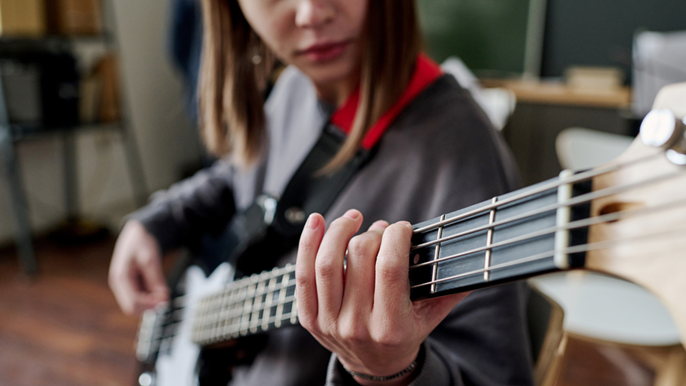
When you first start playing bass, tone can feel like a mystery. You twist some knobs, try a different pedal, maybe swap strings—and sometimes it sounds better, sometimes worse, and you’re not exactly sure why. In a structured, professional bass program, those mysteries start to unravel fast.
Here are nine gear and tone secrets bass students typically discover once they dive into a serious course of study.
1. Your Hands Are the First “Piece of Gear”
Before amps, pedals, or boutique pickups, your tone starts in your hands.
Students quickly learn how much difference it makes to:
- Pluck closer to the neck for a round, warm tone
- Move toward the bridge for a tighter, more aggressive attack
- Adjust finger pressure and dynamics instead of relying only on volume knobs
Changing your technique—attack, angle, and position—often has a bigger impact than buying new gear.
2. String Choice Changes Everything
In a professional setting, you’ll usually get to experiment with different string types and gauges. That’s when you realize how dramatic the changes can be.
- Roundwounds: Bright, punchy, with lots of growl and finger noise
- Flatwounds: Warm, smooth, with a vintage feel and less top-end bite
- Light gauge: Easier to play, more flexible, slightly less fundamental
- Heavy gauge: More tension, fatter low end, great for drop tunings
Students often discover they’ve been fighting their strings without realizing it—and that matching strings to style is key.
3. Pickup Selection Is More Than Just “Neck or Bridge”
Many basses have multiple pickup configurations, but a lot of beginners treat the selector switch like an on/off button. In structured training, you learn how to use pickups strategically:
- Blending neck and bridge pickups for a balanced tone
- Soloing the bridge pickup for definition in rock and funk
- Leaning on the neck pickup for reggae, soul, and warm ballads
You also learn how pickup height affects output, clarity, and sustain—something many players never touch.
4. EQ on Your Bass and Amp Isn’t “Set and Forget”
One of the biggest tone unlocks is learning that EQ isn’t just about taste—it’s about context.
Students learn to:
- Cut low mids to reduce muddiness in a dense mix
- Boost low mids to add punch and presence
- Tame harsh high frequencies instead of turning down all treble
- Sculpt a different EQ curve for practice, studio, and stage
Instead of turning every knob to noon, you learn to listen for what the band and the room actually need.
5. Active vs. Passive: When Each Shines
Many bass students show up not really knowing the difference between active and passive electronics—beyond “one is louder.” In a professional program, you get to hear and feel how each behaves.
- Passive: Organic, warm, responsive to touch; great for classic tones
- Active: More headroom, onboard EQ, cleaner modern sound; ideal for cutting through busy mixes
You also learn how to manage battery life, avoid clipping, and choose the right instrument for the gig or recording.
6. Compression: The Secret Glue
Compression can be intimidating at first, but once it’s explained and demonstrated properly, it becomes one of your most trusted tools.
You discover how compression:
- Evens out inconsistent dynamics
- Adds sustain and punch without making you louder
- Helps your bass sit in a mix with drums and guitars
Students practice using compressors in pedals, amps, and DAWs, learning how attack and release settings change the feel of the groove.
7. Pedals Are Tools, Not Toys
It’s easy to get lost in pedal culture—overdrive, chorus, octave, envelope filters, and more. In a professional environment, you learn to use pedals with intention.
You figure out:
- Which effects actually support specific genres and gigs
- How to set gain staging so pedals enhance, not destroy, your core tone
- Where to place pedals in the signal chain for the clearest results
Instead of building a random board, you build a rig that serves the music.
8. The Room and Stage Matter as Much as the Amp
Students are often surprised to learn how much the physical space affects their sound. In bass playing classes, you’ll likely play in different rooms, rehearsal spaces, and live settings, and hear the same rig sound totally different.
You learn to:
- Adjust your EQ to compensate for boomy or dead rooms
- Position your amp and cabinet for better projection and clarity
- Work with PA systems and sound engineers instead of fighting them
This is the difference between a bedroom tone and a professional, stage-ready sound.
9. Consistent Tone Is a Professional Skill
The final secret isn’t about any single piece of gear—it’s about consistency. Professional programs emphasize building a tone “baseline” that you can recreate on different stages, in different studios, and with different rigs.
Students learn to:
- Take notes or photos of settings that work
- Build a simple signal path that travels well
- Adapt quickly to backline gear while still sounding like themselves
In the end, the real secret is that tone is a combination of knowledge, ears, and experience. Gear matters—but how you understand and use that gear matters more.
With the right guidance, you move from guessing and copying other people’s settings to confidently crafting your own signature sound, no matter what bass or amp is in your hands.
